
As the end of the year approaches, we asked UVA Library staff to recommend their favorite books they read in 2025. The books could be any genre, published in any year, so long as they were available in UVA Library’s or the Jefferson-Madison Regional Library’s collections.
Take a look at our extensive list below, which includes everything from Jane Austen to Andy Weir, and check some books out for the holidays. Members of the UVA community can even request books ahead of time for easy access. Please note: the publication years listed correspond with the editions in our collections, not necessarily the original publication dates.
Happy reading, and come visit us at any of our six locations before we close for winter break (beginning Dec. 20 for some libraries) … or after we reopen January 2!
Recommended by Cory Capron, Receiving & Cataloging Specialist

“Tender is the Flesh” by Agustina María Bazterrica, translated by Sarah Moses. (Scribner, 2020)
I know I’m not the first (see last year’s list) to recommend this gruesome, utterly harrowing novel about a near future where cannibalism is legalized, commercialized, and even somehow normalized, but the praise is well-earned. As far-fetched as the dystopian premise might seem, Bazterrica’s examination of how people compartmentalize their emotions, values, ethics, and morality to facilitate human exploitation while maintaining a semblance of humanity is an uncomfortably grounded read, as fascinating as it is devastating. A soul gouging masterpiece!
“High-Rise” by J.G. Ballard (Holt, Rinehart and Winston, 1975)
Evocative of John B. Calhoun’s Rat Utopia experiments, the novel follows several tenants of a futuristic and seemingly self-sufficient 40-story high-rise as facilities fail and class divides between the bottom, middle, and upper floors are stressed to their limits. While the breakdown into savage violence and dehumanizing depravity feels less nuanced than that of “Tender is the Flesh,” Ballard’s novel remains inescapably influential in its examination of behavior within spatial architectures of hierarchy, functional inadequacy, and confinement, echoed in later works like José Saramago’s “Blindness” and Jacques Lob’s “Snowpiercer.”
“Rhinoceros” by Eugène Ionesco (Holt, Rinehart and Winston, 1961)
The greatest danger of any political comedy lies in the capacity of laughter to diffuse outrage when it should provoke change. A play about townsfolk slowly turning into rhinoceroses as a critique of how easily ideologies like fascism spread amongst even kind and reasonable people would seem a perfect example of such a conciliatory set-up, but the beauty of Ionesco’s whimsical absurdism lies in how it weaponizes its comedy to reinforce the reasoning for inaction and indoctrination amongst its characters, leaving the audience to watch as humanity dwindles in a spiral of cheerful compromises until hopelessly outnumbered in an experience that felt less like a dark comedy than a horror of broad daylight.
“Project Hail Mary” by Andy Weir (Ballantine Books, 2021)
There is nothing bolder and more necessary for great contemporary science fiction to accomplish than inspiring sincere optimism and wonder for science and humanity. Andy Weir’s popularity is well-earned thanks to his uncanny knack for making long passages about math and engineering problems completely engaging, rivaled only by his ability to convincingly portray competent people working together, despite their many human (and alien) faults, to solve problems with life-or-death stakes that lack simple solutions. He is also very, very funny (and in a good way).
“By the Lingering Light of a Slowly Dying Sun” by Tyler Landry (Strangers Publishing, 2023)
The beauty of comics and graphic novels is often in how much the greats of the medium can imbue so few (sometimes wordless) panels and pages with startling emotional power. In this brief exercise in subtlety and restraint, we follow a contemporary man visiting his new neighbors, a small family volunteering to help him adjust after 200 years in cryo-sleep to their new utopian world, a place where both everyone he knew and loved is gone, along with all the seemingly insurmountable environmental and political problems of our time. It’s a whispered gut punch of hope.
Recommended by Jean Cooper, Principal Cataloger
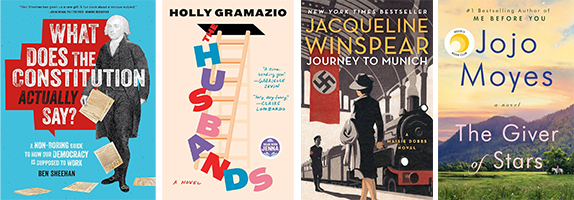
“The Husbands” by Holly Gramazio (Doubleday, 2024)
This is an interesting sort-of-science-fiction, sort-of-not story. Lauren comes home one evening and discovers a man in her condo. A man who says he’s her husband. However, Lauren is not married. Then the husband goes up to the attic, and when he comes down the stairs, he’s a different person. A totally different person. What I found most amusing was how Lauren reacted to each of the different husbands who enter her life.
“The Giver of Stars” by Jojo Moyes (Viking, 2019)
This book is a novel that takes place during Eleanor Roosevelt’s program called the “Horseback Librarians” who delivered books to Kentucky mountain folk during the Great Depression. The story involves five women, their adventures and heroics in the mountains, and a mystery.
“Journey to Munich” by Jacqueline Winspear (Harper, 2016)
In this installment of the Maisie Dobbs series, it’s 1938 and the relationship between the British and German governments is extremely touchy. The British government asks Maisie to travel to Munich to retrieve a scientist who is imprisoned there. The Germans will only allow the scientist to leave in the custody of a family member — but all of this man’s family is dead. Maisie must step into the role of the man’s dead daughter to fool the Germans.
“What Does the Constitution Actually Say?” by Ben Sheehan (Black Dog & Leventhal Publishers, 2024)
I found this book fascinating as it describes, in plain language, what the U.S. Constitution says. It’s wonderfully clear for those who think legalese is a foreign language.
Recommended by Nicholas Cummins, Research Librarian for Economics & Commerce
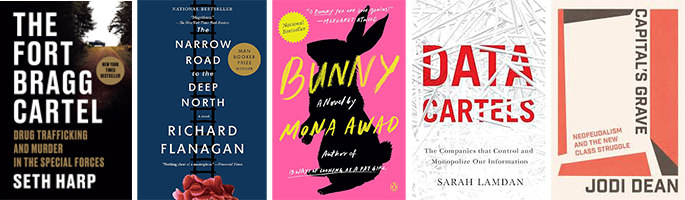
“The Fort Bragg Cartel: Drug Trafficking and Murder in the Special Forces” by Seth Harp (Viking, 2025)
Reading Harp’s jaw-dropping account of rampant criminality in the military’s special forces units (e.g., Delta Force, Navy SEALs) is like flicking on the light switch in a dark basement: for a moment, you can see all the rats and roaches as they scuttle for cover. Impressively, Harp not only honors the many victims named throughout his book — he also manages to humanize some of the perpetrators, too. Without excusing their crimes, Harp deftly describes how officially sanctioned violence leads to moral injury and psychological trauma in the soldiers that follow inhumane orders. Violence inevitably begets more violence. The real culprit, of course, is the imposition of American global hegemony at the barrel of a gun: behind the curtain stand government officials feeding innocent people (both home and abroad) to the meatgrinder of American imperialism.
“Data Cartels: The Companies that Control and Monopolize Our Information” by Sarah Lamdan (Stanford University Press, 2023)
As a business librarian, much of my work centers on facilitating access to and assisting with the use of databases. Many of these databases are extremely expensive, and sometimes the data therein is simply repurposed and repackaged from otherwise freely available sources. Companies like RELX, Thomson-Reuters, and Bloomberg use a variety of unethical business tactics to form monopolies — they are, in other words, the titular data cartels. A law librarian by training, Lamdan argues persuasively for the regulation of data brokers and tech companies as a solution to problems of privacy, accessibility, and fairness. However, Lamdan’s book was published in 2023: if her predictions were made on the precipice, then we are now waving up from the bottom of the cliff.
“Capital’s Grave: Neofeudalism and the New Class Struggle” by Jodi Dean (Verso, 2025)
Most of us would likely agree that things are bad right now, but what if I told you that things could get even worse? Having reviewed this book for a journal earlier this year, I would highly recommend this book to anyone trying to understand why our current socio-economic situation has come to bear an alarming resemblance to the feudal arrangements of medieval Europe. Dean does an incredible job of synthesizing an extraordinary amount of material into a relatively short book, and as in her other work, offers suggestions for how we might fight for a better, more equitable future.
“The Narrow Road to the Deep North” by Richard Flanagan (Knopf, 2014)
Recently adapted as an Amazon Prime miniseries starring the now-ubiquitous Jacob Elordi, this Booker Prize-winning novel uses the Railway of Death as a vehicle to explore the human psyche. Part romance and part war story, Flanagan beautifully describes the brutality, love, cruelty, and hope that exists simultaneously in all people. Interestingly, this book is one of the few English-language works that references the oft-overlooked Unit 731, a truly nauseating element of the Imperial Japanese Army that conducted human experiments that would make Josef Mengele jealous.
“Bunny: A Novel” by Mona Awad (Viking, 2019)
Murder, black magic, and hallucinations are bad, yes, but none are as horrifying as writer’s block. Those that have been through graduate school know that surviving the ordeal is difficult enough without having to also contend with magical realism, ritual transformations, and mysterious strangers. Occasionally gory but always mischievous, this darkly comedic novel is best read at that time of year when autumn leaves are at their most desiccated.
Recommended by Sue Donovan, Conservator for Special Collections

“Bury our Bones in the Midnight Soil” by V.E. Schwab (Tor Books, 2025)
Just jump into this one; it’ll surprise you.
“The Pull of the Stars” by Emma Donoghue (Little, Brown and Company, 2020)
Incredible, captivating writing about a nurse in a maternity ward during the 1918 flu pandemic in a country already torn by war.
“The Frozen River” by Ariel Lawhon (Doubleday, 2023)
Well-researched novel of a real-life midwife fighting for justice for a victim of a terrible crime in post-revolutionary Maine.
“The Mighty Red” by Louise Erdrich (Harper, 2024)
Erdrich strikes again: beautiful exploration of love, loss, Native communities and family, farming, friendship, guilt, grief ... Incredible storytelling, as always.
“Detransition, Baby” by Torrey Peters (One World, 2020)
A striking story of the lives of women — transgender and cisgender — with unique characters that are flawed in a way that isn’t stereotyping or cruel … just human. I loved getting to read and experience these different perspectives.
Recommended by Bret Heddleston, Print Periodicals Specialist
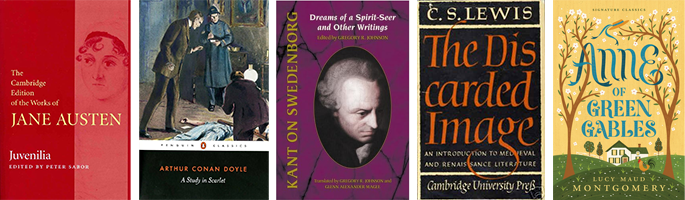
“Juvenilia” by Jane Austen, edited by Peter Sabor (Cambridge University Press, 2006)
How better to commemorate the 250th anniversary of Jane’s birth than to speculate about how the chaotic and precocious teenage author of “Love and Freindship” [spelling original] became the refined misanthrope narrating “Pride and Prejudice” and “Emma”? Standout performances are “The History of England” starring Mary Stuart and the haters, and “Jack and Alice” starring … no one in particular and a teenage girl who just can’t get sober.
“The Discarded Image” by C.S. Lewis (Cambridge University Press, 1967)
Probably you know him for “Narnia” but, as a scholar, C.S. Lewis also wrote this survey of medieval cosmology. Turns out that the man known for world-wardrobes and cockney-accented beavers never wrote about a weirder world than the one medieval Europeans thought they lived in.
“Dreams of a Spirit Seer” by Immanuel Kant (Swedenborg Foundation, 2002)
I was curious to see if the great philosopher’s early preoccupation with the extravagant visions of his contemporary, Emanuel Swedenborg, led to his developing useful arguments for their impossibility. As it turns out, Swedenborg’s visions of a spiritual universe parallel to the physical and governing human behavior with strict moral laws may have influenced Kant’s phenomena/noumena dualism and his categorical imperative, respectively.
“Anne of Green Gables” by Lucy Maud Montgomery (Bantam Books, 1935)
I started it because I heard there were interesting character developments in the sequel and a weirdly faithful Studio Ghibli adaptation. But I stayed for Anne Shirley’s Tinkerbell-violent emotional outbursts and colorful vocabulary, and because it’s a relatable book for people with a lot of nieces.
“A Study in Scarlet” by Arthur Conan Doyle (Penguin, 2001)
I actually started Sherlock with “His Last Bow,” but was informed that that is a perverse and misguided decision (which is true). This one is more fun, introducing a Sherlock who knows all of chemistry, geology, etc., but does not happen to know that the Earth revolves around the sun.
Recommended by Jenn Huck, Associate Director, Research Data Services & Social, Natural, and Engineering Sciences
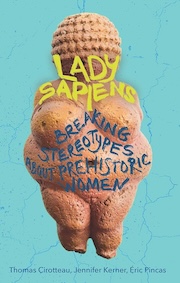 “Lady Sapiens: Breaking Stereotypes About Prehistoric Women” by Thomas Cirotteau, Jennifer Kerner, and Éric Pincas; translated by Philippa Hurd (Hero 2022)
I loved reading about how a new generation of researchers are shedding light on the daily life and social roles of prehistoric women. It was fascinating to try to imagine what life might have been like for women so long ago, and what would have been important to people then. (Fertility was higher up the list than I realized.) This was a great pick from our new Popular Science collection in Brown Library!
Recommended by Ervin L. Jordan Jr., Research Archivist
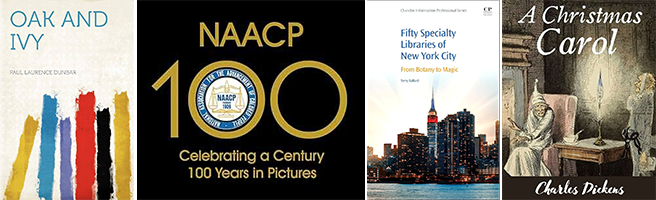
“Oak and Ivy” by Paul Laurence Dunbar (Press of the United Brethren Publishing House, 1893)
Paul Laurence Dunbar (1872–1906), son of former Kentucky slaves, became the first African American poet of national and international renown. At age 20, while working as an elevator operator, he self-published “Oak and Ivy,” a 62‑page volume of 56 poems dedicated to his mother, Matilda Burton Dunbar, with whom he shared a close bond. I enjoyed the volume because Dunbar broke barriers in his own time and inspired generations, enduring as a living force in American literature.
“50 Specialty Libraries of New York City: From Botany to Magic by Terry Ballard” (Chandos Publishing, 2016)
This eclectic guidebook is not a resource just for librarians. Its focus is on the rich network of libraries, archives, and historical societies across New York City’s five boroughs, each devoted to specialized subjects ranging from the American Kennel Club to botanical gardens, civic and government records, entertainment, law, medicine, parapsychology, rare books, services for the blind, and the legacy of musician Louis Armstrong. This resource is as useful for planning visits as it is for appreciating New York’s vibrant cultural landscape. It appealed to me as a reminder that libraries are living archives preserving voices, experiences, and cultural memories.
“NAACP: Celebrating a Century: 100 Years in Pictures by the National Association for the Advancement of Colored People” (Gibbs Smith, 2009)
At four pounds and 456 pages, this book’s true weight lies in its emotional and historical significance. Through painful, powerful photographs with accompanying text, it documents the story of America’s oldest and largest civil rights organization — the National Association for the Advancement of Colored People (NAACP), and its official journal, “The Crisis,” established in 1910. Each decade receives its own chapter, tracing the NAACP’s relentless fight against inequality, racism, social injustice, and voter suppression. As a child of the Civil Rights era, I appreciated this book as it expands our collective memory and inclusion in America’s story, linking yesterday’s struggles to today’s unfinished work.
“A Christmas Carol. In Prose. Being a Ghost Story of Christmas” by Charles Dickens; illustrated by John Leech (Chapman & Hall, 1843)
Written in just six weeks during a time of personal financial strain and faltering book sales, Charles Dickens transformed necessity into a timeless moral message. He produced a novella that has never gone out of print, selling nearly 10,000 copies by Christmas Eve of its first year. Determined to make the book a festive offering, Dickens paid its publication costs, insisting on a lavish production — bound in red cloth with gilt edges, hand‑colored engravings, and festive endpapers. Combining ghost story elements with a moral allegory, Dickens reshaped the way people thought about the holiday.
This memorable page-turner is one of my favorites for its vivid, easy-to-read style evocative of warm familial memories of Christmases past and the hopefulness of Christmases yet to come.
Recommended by Carla Lee, Deputy Librarian

“The Road to Tender Hearts” by Annie Hartnett (Ballantine Books, 2025)
The best phrase to describe this book is “quirky — in a good way.” An anything but classic road-trip novel with a wry sense of humor and a lot of heart.
“Station Eleven” by Emily St. John Mandel (Knopf, 2014)
I found this book unsettling, inspiring, moving, and perfect. It’s been turned into a highly acclaimed series on HBO, but I found I couldn’t watch it, because any change from the source material felt like such a loss. This the book I couldn’t stop recommending all year.
“Lila” by Marilynne Robinson (Farrar, Straus and Giroux, 2014)
This is the third of a series that began with “Gilead.” Each of the books takes a different character’s viewpoints and perspectives and I found Lila’s book thoroughly engaging. She grew up unhoused through the Dust Bowl and Great Depression and the story of her adjustment to being cared for is an unusual piece of historical fiction.
“City of Thieves” by David Benioff (Viking, 2008)
This adventure of two men on a quest for a dozen eggs during the siege of Leningrad is not my usual profile, but the dark comedy and adventure really worked for me. It is filled with well-drawn characters and was a real page turner for me.
Recommended by Bethany Mickel, Instructional Design & OER Librarian
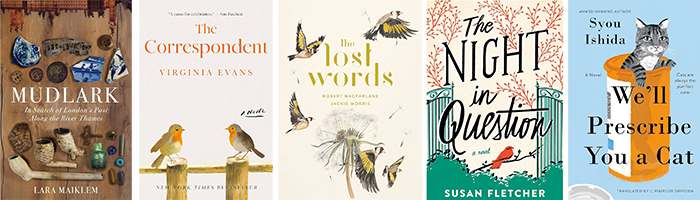
“The Correspondent” by Virginia Evans (Crown, 2025)
Sybil Van Antwerp is an unforgettable protagonist. She’s a combination of wisdom, snark, reflection, and honesty; and her letters made me laugh, cry, and reconsider my own memories and relationships. This epistolary novel surfaced thoughts of connections I’ve made and forgotten; forgiveness, both for myself and others; and it was just the remedy I needed at the right time.
“We’ll Prescribe You a Cat” by Syou Ishida (Berkley, 2024)
In a year where I’ve desperately sought comfort and calm, “We’ll Prescribe You a Cat” read like a love letter to the pure joy of the unshakeable bond of feline friends. The Kokoro Clinic for the Soul is a wonderous place where troubled people aren’t prescribed traditional medicine; instead, they’re prescribed a cat. It is a heartwarming blend of humor, science, and the finding just the right thing when you needed it most.
“Mudlark: In Search of London’s Past Along the River Thames” by Lara Maiklem (Liveright Publishing Corporation, 2019)
A lover of hidden stories, I enjoyed this blend of history, archaeology, and the author’s own reflection of her time “mudlarking” on the banks of the River Thames. Her discoveries include Tudor shoes, pilgrim badges, Victorian toys, and even pieces of Doves Type typeface that were discarded by its creator. The book made me pause and think about serendipitous discovery and what the “things” we hold onto say about ourselves and the time in which we live.
“The Night in Question” by Susan Fletcher (Union Square & Co, 2024)
This novel is rich in atmosphere with just the right amount of tenderness and mystery at its heart, and I was left questioning what it means to navigate this messy world with the capacity to forgive and be forgiven. Anyone with an aging loved one will recognize the quiet heartbreak and the fierce determination of these characters who have stayed with me long after the book was read.
“The Lost Words” by Robert Macfarlane (House of Anansi Press, 2018)
Otter, acorn, wren, raven, willow, bramble, heron. These are just a few of the words that are slowly disappearing from children's dictionaries. In this lovely, illustrated “spell book,” Macfarlane uses poetry as a “spell” to evoke the presence of the word while Jackie Morris’ illustrations bring the images to life. I’ve loved this book myself and gifted it to friends’ children as a love song to the irreplaceable things in our natural world.
Recommended by Brittany Murray, UVA (CAV) Collections Conservator
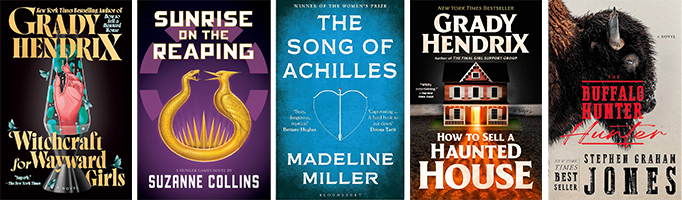
“Buffalo Hunter Hunter” by Stephen Graham Jones (S&S/Saga Press, 2025)
This book was about a Native American vampire hunter on a revenge crusade. Very scary, very gory, kinda sacrilegious, and lots of good twists and turns. There was a very inaccurate depiction of book conservation at the beginning of the book, but the story was great, otherwise.
“Sunrise on the Reaping” by Suzanne Collins (Scholastic, 2025)
Suzanne Collins has mastered the art of writing a good prequel. Every installment of the Hunger Games, in my opinion, has been spectacular. This book focuses on Haymitch Abernathy, Katniss Everdeen’s mentor. It was filled with action, adventure, camaraderie, and gore. You understand why Haymitch is the way he is because of this book, and I am grateful that he finally got his happy ending.
“The Song of Achillies” by Madeline Miller (Ecco, 2012)
Don’t listen to this audio book while driving because the road will be blurry. This was a beautiful retelling of the Iliad, focusing on the relationship between Achilles and Patroclus.
“How to Sell a Haunted House” by Grady Hendrix (Berkley, 2023)
I learned about puppet ministries because of this book! A great blend of comedy and horror. Grady Hendrix is an incredibly talented writer.
“Witchcraft for Wayward Girls” by Grady Hendrix (Berkley, 2025)
Another great read by Grady Hendrix, this story took place in St. Augustine, FL (I am from Florida) in the 70s, in a home for pregnant teenage girls. There is a spooky book cart, very detailed descriptions of childbirth, and camaraderie.
Recommended by Cecelia Parks, Undergraduate Student Success Librarian
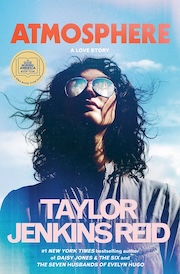 “Atmosphere: A Love Story” by Taylor Jenkins Reid (Ballantine Books, 2025)
“Atmosphere” is part queer love story, part thriller, part historical fiction. It follows fictional astronaut Joan Goodwin’s journey as one of the first female participants in NASA’s Space Shuttle program in the 1980s. Joan develops a relationship with a fellow astronaut and is faced with a life-or-death crisis on a space shuttle in which impossible choices must be made. No spoilers, but I haven’t cried so hard reading a book (in a good way!) in a long time.
Recommended by Leigh Rockey, Librarian for Collections Management and Video Resources

“Drive Your Plow Over the Bones of the Dead” by Olga Tokarczuk, translated from Polish by Antonia Lloyd-Jones (Riverhead, 2018)
Have animals started knocking off local hunters in Janina’s small rural village? She thinks that's what the evidence shows. Originally published in Polish in 2009, then nine years later translated to English, this dark but ultimately illuminating tale of murderous revenge was shortlisted for the 2019 International Booker Prize and longlisted for the 2019 National Book Award for Translated Literature. Tokarczuk is the winner of the 2018 Nobel Prize in Literature.
“Nuclear War: A Scenario” by Annie Jacobsen (Dutton, 2024)
Readers who were cognizant during the Cold War will recognize the sweaty, squirmy feeling they get from Jacobsen's fast-paced, fact-packed play-by-play of nuclear annihilation. It’s a thoroughly researched narrative of a nuclear war based on North Korea launching a few nuclear warheads at the U.S. and the terrible but real consequences. The scariest thing is that this book is categorized as non-fiction.
“North Woods” by Daniel Mason (Random House, 2023)
One of the best of this book’s many pleasures is the invention of pomomania, obsession with apples. There are also ballad lyrics, tabloid news articles, letters, diary entries, real estate ads, case notes, and straightforward narrative. It’s all in the service of a story about a parcel of land in Western Massachusetts and the many people over the centuries who have lived there.
Recommended by Douglas Ross, Programmer Analyst
“All Systems Red: The Murderbot Diaries” by Martha Wells (Tom Doherty Associates, 2017)
The first (second chronologically) in Wells’ “Murderbot Diaries” series. I did not expect to enjoy these. I like my science fiction hard, and pedantic. Not like this. Not hilarious, with brilliant, deadpan wit. I recommend the entire series.
“Dead Astronauts” by Jeff VanderMeer (MCD/Farrar, Straus and Giroux, 2019)
Bizarre. Horrific. Genius. Technically a stand-alone novel taking place in VanderMeer’s weird-fiction “Borne” universe. I’d read the preceding novel, “Borne,” and novella “The Strange Bird” last year. I recommend them all, read in chronological order.
“The House of Mirth” by Edith Wharton (Scribner Classics, 1997)
Damn, she’s good! I think I liked this one even more than “The Age of Innocence.” How had I not read these until now?!?! Next up, her ghost stories.
Recommended by Hope Shinn, Scholarly Repository Librarian
“Everything Is Tuberculosis: The History and Persistence of Our Deadliest Infection” by John Green (Crash Course Books, 2025)
Very engaging book about tuberculosis, its impact on our culture, and how more than a million people still die from it each year in countries without robust health systems. I confess to being a long-time fan of John Green and his books — but this is, in my opinion, his best writing yet.
“Is a River Alive?” by Robert Macfarlane (W.W. Norton & Company, 2025)
Natural history/travelogue that makes a compelling case for why we should recognize rivers as living beings with legal rights. It’s a concept that I had never encountered before, but it resonated with me deeply, and I’m still thinking about this book months after I finished it.
“Gaudy Night” by Dorothy L. Sayers (Harper, 1936)
An alumna of a women's college at Oxford — herself a writer of murder mysteries — is called back to her college to investigate “poison-pen” letters being sent to its students and professors. It’s an unassuming premise, but this book is one of the best of the Golden Age detective novels. The mystery is satisfying, the characters feel like real, living people, and Sayers really captures the experience of returning to a university campus as an adult. Not to mention that it contains some of the best discussions of feminism I’ve ever encountered in fiction (and that are still sadly relevant nearly 100 years after it was written). I re-read “Gaudy Night” every couple of years and it gets better every time.
Recommended by Ronja Zweifel, Cataloging Librarian
“Proto: How One Ancient Language Went Global” by Laura Spinney (Bloomsbury Publishing, 2025)
This book is about how linguists and scientists have traced the origins of the Proto Indo-European language back over thousands of years. It’s a fascinating look at how language evolves but I also learned so much about how people lived in prehistoric times as they combined the linguistic side with archaeology and human genetics to look back beyond written history.
“Gideon the Ninth” by Tamsyn Muir (Tom Doherty Associates, 2019)
Has it been recommended a million times? Probably. But I reread it this year and wow did I see so much more happening on the second go-through. Muir is so fantastic at writing an unreliable narrator who has no idea what’s going on around her (also, Gideon’s sense of humor about it is so great). Neither the reader nor Gideon have any idea what’s happening in this book until we all stumble to the end and go “Wait, WHAT?” I love this book so much.